
October 2025
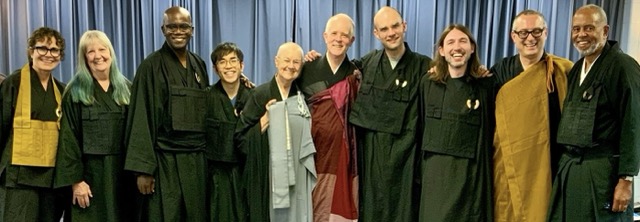
We Zen students can be so hard on ourselves, so serious—it’s always work work work, practice practice practice—but it’s important to remember to celebrate sometimes, too. This Friday, October 3rd, the Village Zendo will be throwing a little party to honor the launch of the new website, Zen Women Pioneers, which features Enkyo Roshi and was created in collaboration with many VZ members. It sounds like a lot of fun, and I hope to be able to attend, and have a little fun myself.
I am not suggesting that our whole existence should be some kind of party (I personally have spent far too much time attempting to live like that, and it’s exhausting and pointless). This life is, after all, the grave matter—and there is much in it that needs to be attended to with the most serious of minds. And yet I do believe that there is room, too, for lightness, joy, celebration—indeed, these elements are essential…
September 2025
I hate the end of summer. It goes back to childhood, probably, when the end of summer meant the end of fun: back to school, back to work, no more sunshine, no more sea. In many ways, I’ve lived my life like this—hanging on to summer with all my might, refusing to let go: of these long, sunlit days, of my youth. If I get the opportunity, I plunge into the ocean in October, early November—the water still warmish but the crisp air biting at you when you get out. Winter, ignored. Middle age be damned.
I mention all this because, well, I’m nearing fifty now and I still don’t want to grow up. I want to be young and stupid forever, even though I know how stupid that would be. Why this resistance to growing, evolving, becoming who I always knew I was meant to be?
July 2025
My mom used to like to talk about how we humans have “built-in forgetters” in us. This explains, for example, why we tend to do the same stupid stuff over and over again. But it also hints at a kind of deeper spiritual pattern: the way we can have those occasional enlightenment moments in which we connect with that unnameable something within us, and for a moment or two (or a day or two), we remember who we really are—before inevitably, we lose touch with this truth, get swept up in the whirlwinds of everyday life, and forget once again. Retreats are a place where these particular circumstances are often played out—you know, how after a week of intensive meditation, we emerge, glowing yet grounded, certain of who we are and what it’s all about—and then a few days later, there we are, yelling at the cat.
In this light, one might point to forgetting as the basic human condition, and remembering as our practice. Yes, this is why we practice—to return to ourselves, and remember who we are—and this is also why, ideally, practice is not just something we do on retreats or on the cushion but instead is a near-constant effort. That way, we can resist our built-in forgetter more consistently—never straying too far before we bring ourselves, again and again and again, back home.
June 2025
The other morning, my son was having a tough time of it. He was refusing to go to school, which he describes as “torture.” It took a few hours before we somehow finally convinced him. As his mom packed up his lunch, I had the sudden inspiration to take Ollie in the back yard for a minute. “Come with me,” I said.
Outside, I led him to a pot of flowering sage, showed him how to rub the leaves in his fingers and then inhale the scent. In the corner of the yard, I had him hug the trunk of the Japanese maple, his favorite tree. “That felt weird,” he said afterwards. We looked closely at a purple bloom of rhododendron—the freckles of the upper petal, the way the middle stamen was tipped with red. We continued on through the yard, looking up at the big trees on the other side of the fence, till we reached the stone buddha, whose eyes had been covered by a stray branch of evergreen taxus. I moved the branch to behind his head, but a spider remained, there on the Buddha’s left eye. I showed Ollie. “Poor buddha,” he said. “Oh, Buddha doesn’t mind,” I responded. “Whatever comes his way, he accepts it.” “Well, that’s because it’s a stone Buddha and it can’t do anything but sit there,” Ollie said. He’s a smart kid.
May 2025
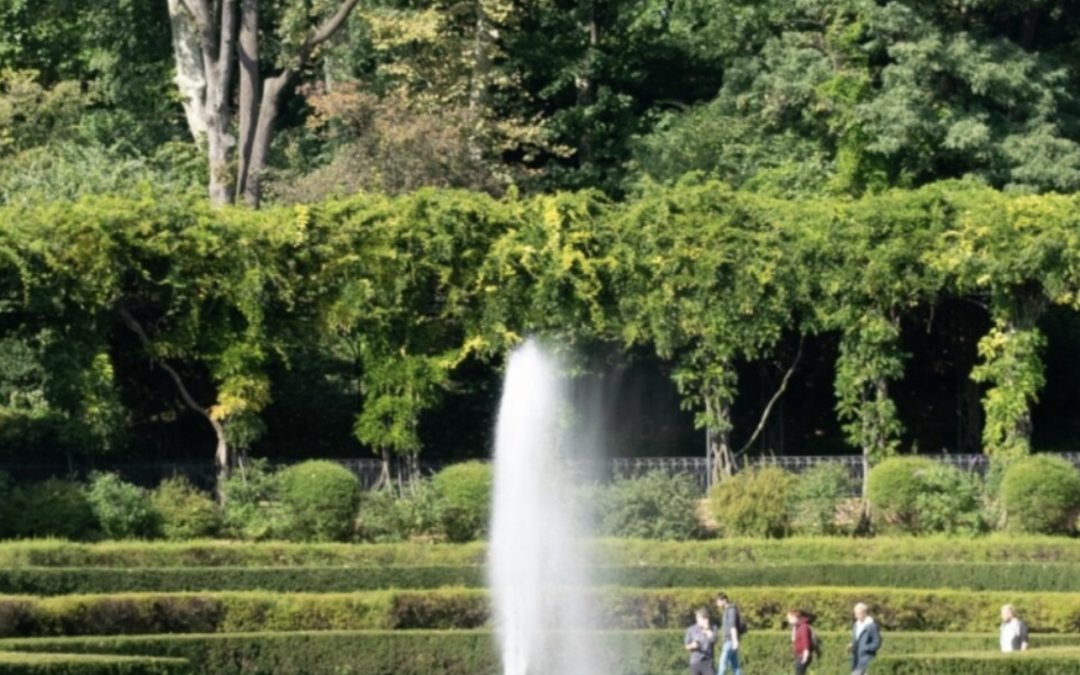
Today I realized that we are in the midst of that rarest and most precious of seasons here in the northeast—beautiful summery weather, yet no mosquitoes. This will not last long. In fact, a week or two ago, I saw a whole swarm of them: newly born, confused, floating about, uncertain what they were supposed to be doing with themselves. I don’t think they’d learned to bite yet. Anyway, I’m pretty sure a frost took care of those ones. But I know it won’t be long now till the little suckers are back, making my yard semi-uninhabitable and doing their best to ruin summer—and our general good time.
I mention this because, well, it’s always something: mosquitoes, allergies, papercuts, stubbed toes, old age, sickness, death. Those uninterrupted moments of true peace and happiness in life that we all long for: I’m not so sure they really exist, at least not in the flawless form we imagine. I am reminded of an anecdote about Suzuki Roshi I read somewhere. He was giving a talk, I guess, and he said something along the lines of, “All of the problems you’re experiencing now…” and then he paused, and everyone listening sort of assumed he was going to say, “will go away”—but instead he finished his statement by saying the opposite: “…will continue for the rest of your lives.”
April 2025
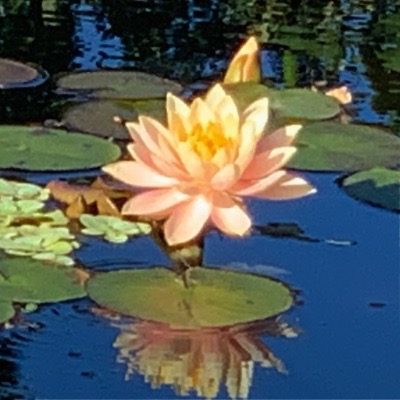
One of the things I love about the spring is the mud. Up in Vermont where my sister lives, they actually have a name for this time of year—Mud Season—all the snow and ground-frost has melted, and the result is thick, wet, dark earth, sucking at tires and boots and pant cuffs and getting all over everything. Down here towards the city, it’s a less dramatic event, but my suburban yard is not immune from the muck, either. After a good romp back there, digging, perhaps, in some forbidden corner of the garden, my dogs show up at the door with their paws and muzzles all muddy and big, happy grins.
I want to show up at my door with a similar look—guilty, disheveled, pleasure-soaked, grass stains on my knees. I’ve had enough of this sanitary existence. I want to get down into the muck of life, and of myself—the mud, after all, is the good stuff: It’s where all the complications are, the nutrients. It’s how the lotus blooms….
March 2025
The other day—a particularly long one—my wife said the words, “I’m cooked.” I got it. I was cooked, too. I have a feeling we’re all kind of cooked, these days. Done. Overdone, actually. Charred to a crisp.
How do we cook our lives when our lives seem to be cooking us?
One simple answer, perhaps, is to remember to be of service—to devote ourselves to something other than ourselves. With “me” at the center of it all, it’s too easy to believe that life is something that happens to me: piling up one problem on top of the next on “my” shoulders. But when you turn it around, and this “me” becomes an offering to something bigger—everything shifts.
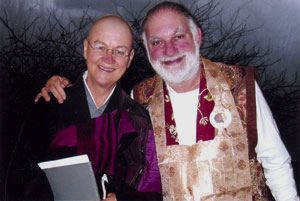
This is what our own longtime tenzo, Seizan, who will be honored on March 9th, reminds us. All along, he has single-mindedly and wholeheartedly poured his efforts into serving our Sangha: delicious meals; scrubbed toilets; his simple, pure, shining presence.
February 2025
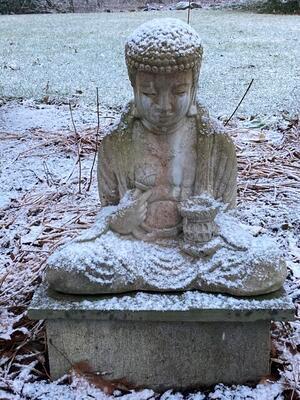
As a writer and editor, I’ve always struggled with the above questions. I know all too well how words can fail, how often they fall short. And yet I know, too, that words are my practice nevertheless. “Ha!” the universe cries. “Ha!” I respond, shaking my head and grinning with resignation.
While words may or may not be your practice, the name of our Zendo, Temple of True Expression, reminds us that to truly express ourselves is part of practice for each and every one of us. This is why I’d like to invite you to be a bigger part of this Bulletin. What this means—and how (or even if) you do this—is of course up to you, but the truth is that there is room here in these pages for you to express yourself truly, and in so many ways: poems, essays, photos, drawings, short stories, interviews, rants, hopes, fears, pleas, mantras, recipes, songs, paintings, prayers… Indeed, the ways you could offer your truth are limited only by your imagination. So, tell me, how will you contribute? (I mean, seriously, tell me: email me at tapink24@aol.com with the headline “Bulletin Ideas” and tell me how you’d like to be a part of this.)
December 2024
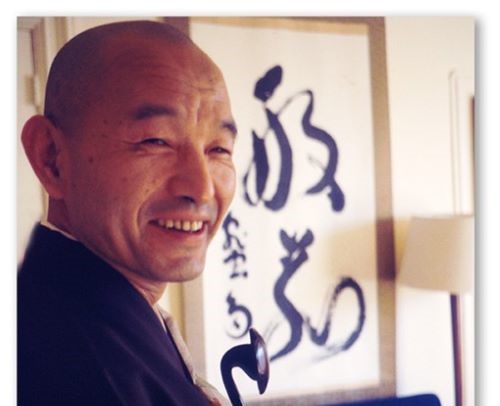
Tis the season of dana, a time not only of giving but also of receiving. Indeed, how we receive something is often as important as how it is given—as Maezumi hints, the act of receiving is itself a kind of gift.
I love the idea that anything—everything—can be a gift—and is. A blade of grass, a stubbed toe, a weathered stone in the shape of a heart. One of the things we chant in our evening gatha is that the dharmas are everywhere—and so it is with gifts: Chances to awaken surround us at all times, offering themselves up. How will we receive them?
We’ve been given some doozies as of late. I wager not many of us were asking the universe for a Trump presidency with a side of Freedom Fries, but that’s of course what we were given. How do we see this as a gift? Is it even possible? And even if we can’t see it as a gift, can we receive it as one?
November 2024
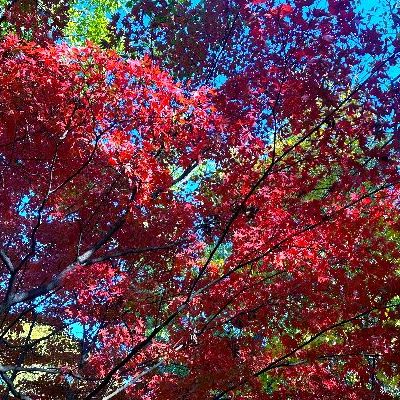
Oh, dear Sangha. It’s always seemed to me that one of the great tenets of Zen is acceptance—just completely and utterly accepting life exactly as it—but it occurred to me just recently what a crushingly heartbreaking ask that is. Accept life as it is, with all its deep, deep suffering? With all that old age, sickness, and death? With the war and the horror and all the infinite innocent creatures torn from this world for no good reason? Oh, it’s a pretty phrase, I guess, accepting life as it is, but the true meaning of it—accepting everything—I don’t know how you can shoulder that burden and not be crushed. Today, I’m feeling pretty crushed by it myself.
It would be too easy, from this point, to slip into nihilism. I mean, if the world is fucked, what’s the point? (Of course, let’s not forget that accepting everything also means embracing all the good, too—all the beauty, and kindness, and love—though this can also be a strangely heartbreaking ask.) Either way, the serenity prayer above, and Zen itself, offers some hope—or if not exactly hope, than at least a path, a direction, a choice: action. The courage to do, and, with all our heart, change what we can. Of course, it takes wisdom to know what can be changed, and what cannot—and I think I’m struggling today with the fact that no matter what I do, this world will still be filled with suffering—I cannot change that fact. No matter what I do, old age, sickness, and death will persist. But perhaps it is only from a place of truly realizing this, and accepting it, that we can finally and freely and truly act.
